file #1: file #2:

file #2:
The article “Pompeo says Saudi-led coalition is trying to reduce Yemen’s civilian casualties” written by “Jennifer Hansler” discusses how Saudi-led coalition is interfering in Yemen’s civil war. The author represented Saudi Arabia and UAE as the savers that only care about reducing the harm and the pain of the civilians. She ignored the other side of the story and only took into consideration the American point of view.
In this article the author argues for Saudi’s intervention in Yemeni war. This war is a civil war in Yemen, which supposed to be a war between groups within the same country. so why is Saudi Arabia interfering and even bombing and why is America giving funds to the Saudi-led coalition? The author claimed that Saudi Arabia is just trying to help the civilians but the other side of the story was hidden and the context was stripped. In reality, Saudi Arabia was not just helping the civilians, it has formed a coalition to overthrow the Houthis in Yemen. Moreover, it is a Saudi-Iranian conflict; Iran is supporting the Houthis and Saudi wants to defeat them. Furthermore, the author conveniently ignores the Sunni-Shia conflict in the region. Saudi Arabia as a majority Sunni country, does not support the Shia Houthis. Additionally, the author discussed the bomb on a Yemeni school bus but ignored that Saudi Arabia had blocked all Yemen’s ports which led to a high risk of famine among Yemen’s civilians. In addition, Saudi Arabia has been targeting civilians specifically, Akram (2017) reports: “According to the Yemen Data Project out of 15,489 attacks, only 5,883 (around one-third of all attacks) were directed at military or security targets, and 294 were targeted at political or tribal figures”. To conclude, the author left out information that is quite important.
Furthermore, this news story is influenced by the mindset and background of the American politics, as is shown by the language that the author uses. She writes that Saudi wants to “limit” the civilian death, as if a certain number of deaths is okay. The author uses a language that dehumanized the victims. In addition, Saudi Arabia wants to reduce the harm to the civilians. But it cannot reduce the “harm” done to a woman who lost her child, or to the children who lost their homes. It is questionable how the Saudi-led coalition bombing will help these people. Thus, this article reports on the harm to civilians and their pain but at the same time it normalizes the suffering of people. Moreover, the author insists that Saudi is taking “demonstrable” action to minimize civilian death, which means that their actions are shown to be true or to exist. It is unclear what steps they are taking to help the civilians and the journalist did not interview a Yemeni civilian to show that these actions are demonstrable. The State Department wants to “achieve a negotiated end to this fighting”” (Hansler, 2018), however they didn’t make clear who will negotiate with whom, and it is not logical how the American wants to do the negotiation on the behalf of the Yemenis in their own civil war. To sum up, through the language the author uses, the article reflects a strongly one sided perspective.
Additionally, the headline “Pompeo says Saudi-led coalition is trying to reduce Yemen’s civilian casualties” presents the Saudi-led coalition as the lifesaver that is trying to help people in need without wanting anything in return. this headline aims at influencing the reader because the people who read only the headline will assume that Saudi Arabia is just interfering to help the civilians and by reading that an “Official says” they will assume that this information is true. The writer waits until the 7th paragraph to explain the Civil war and its causes, even though this is the most important information in order for the reader to understand the story. Although, the first paragraph shows how Saudi-led coalition helps the civilians: “the governments of Saudi Arabia and United Arab Emirates are undertaking demonstrable actions to reduce the risk of harm to civilians and civilian infrastructure” (Hansler, 2018)”. This control of placement of information can mislead the reader into having an inaccurate view of the whole picture. In addition, in the last paragraph the author quotes the words of a “spokesperson”. The author tries to give authority to his words but by quoting the words of some unknown official, it is not a trustworthy person.
The news reflects the views of the organization stating it, as a result, the reader should always take into consideration the origin of the news. Most of the information in this article were provided by the Secretary of State Mike Pompeo who is an American politician, which means it only includes the perspective of an American person. On the other hand, the Yemeni perspective was left out. The reporter failed to explain how the Yemen civilians are suffering or what they want to say about their own civil war. Excluding the other perspective may change the situation to favor one side. The author includes the claims of the American military officials in all his article, and nearly all he said was based on their claims. The second page is full of statements made by the “official”. For example, these statements include: “We will continue to work closely with the Saudi- led coalition to ensure Saudi Arabia and the UAE maintain support for UN-led efforts to end the civil war in Yemen…” Pompeo said, (Hansler, 2018)” . Moreover, the claims of the American military manufacture the news and produce propagandistic statement. In other words, “media outlets typically state as fact what are nothing more than official assertions, and then append on to the end of the paragraph the rote phrase “officials say” (Greenwald, 2012). They want to manipulate public opinion, and shape it in a way that comfort the people holding power. The whole article is designed by the claims of officials, which transforms the free press into political channels. Even though it is a news story about Yemen, Saudi Arabia and the UAE, an American connection must exist. Otherwise stated, “The American filter in the media’s coverage of international news, the notion of relevance to the United States, is very important” (Moeller, 1999). Americans tend to believe or feel closer to the information coming from an American source, even when the story is about Arab countries the press includes the American point of view.
Furthermore, the media gives the information required for the public to participate in political activity. They do not provide the full story and wait for the public opinion; instead they deliver the right kind of information so the public can think the way they want to. In this article the full story was not offered; we did not hear the opinion of the other political side. In other words, “Democracy is staged with the help of media that works as propaganda machines” (Chomsky,2017). It is not a simple process; the media doesn’t simply deliver the information in hand. Media firms aren’t free press, they are owned by huge corporations. You will rarely see a news that contradict with the people in power’s opinion. The media is influenced by governments, in this article The information given are from the Secretary of State Mike Pompeo. Therefore, it delivers the information needed for the public to follow the people holding power.
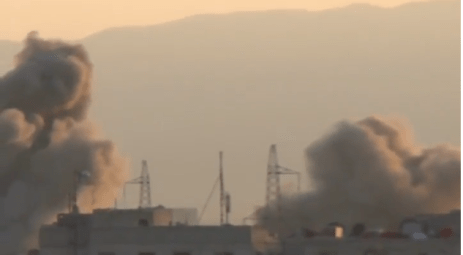
Additionally, it is believed that the camera is the most objective tool to picture a moment. Most People used to and still sometimes ignore the fact that the photo is highly influenced by the photographer; it reflects his belief and culture. In other words, “the belief that “the camera never lies” betrays the fact that someone chose what, when, where, why, and how to photograph” (Share, n.d). The first photo in this article is a dramatic picture showing the war in Yemen. The photo is dark and out of focus, and it is taken from a far distance. It is a dramatic way to show war, we don’t even know if this is in Yemen or not, but this is the typical way to show the disastrous war. It freezes the moment of a bomb, to represent how bad the civil war is and to show that Saudi Arabia and UAE are helping the civilians out of this catastrophe mess. Contrarily, the videos are clickable, you can’t watch them on the same page of the article. Usually people won’t click and watch the video and maybe that is what the author wants to, because this is a bad news about Saudi-led coalition. But they had to report this news, a massacre of children on a school bus has to be reported. They already removed enough information, they can’t remove this one too. they ignored the fact that there is plenty of other mistakes (first paragraph of my paper) and if we look closer on the way they narrated this news, we can notice that they tried to explain that this was a mistake and Saudi is better now and that America won’t let it happen again. As if bombing and killing innocent children is a normal “mistake”.
In conclusion, this article reflects a strongly one sided perspective and narrates the story in a way that manipulate the public. In addition, the author talks about the suffering and harm to civilians, while normalizing it at the same time.
References:
Akram, S. (2017, december 29). It’s time to get real about the death toll in Yemen. The New Arab. Retrieved from
https://www.alaraby.co.uk/english/comment/2017/12/29/its-time-to-get-real-about-yemens-death-toll
Al Jazeera English (2017). Noam Chomsky, The 5 filter of tne mass media machine. Available
from https://www.youtube.com/watch?v=34LGPIXvU5M
Greenwald, G. (2012, June 17). “Officials say” journalism. Salon. Retrieved from
https://www.salon.com/2012/06/17/officials_say_journalism/
Hansler, J. (2018, september 2018). Pompeo says Saudi-led coalition is trying to reduce Yemen’s civilian casualties. CNN politics. Retrieved from
https://edition.cnn.com/2018/09/12/politics/pompeo-yemen-ndaa/index.html?no-st=1538302134
Moeller, S. (1999). Four Habits Of International News Reporting. In compassion fatigue. London: Routledge. Retrieved from
https://frameworksinstitute.org/assets/files/PDF_GII/four_habits_of_news_reporting.pdf
Share, J. (n.d). camera always lies: breaking the myth fo journalistic objectivity. Retrieved from
Syrian refugees are citizens of Syria, who have fled from their country since the onset of the Syrian civil war in 2011 and have sought asylum in other parts of the world. Here are 4 different stories about Syrian refugees from 4 different sources.

Some people never make it past the headlines, thinking the entire story has been boiled down to that bold print. This headline is written in an emotional language and in bold, plus it includes the imagery “memories lost and futures on hold” to make a sensational statement and to grab the reader’s attention, thinking that a dramatic and sensationalized coverage makes readers believe that this merit their attention and will continue to read the whole article. Not only is the headline important but also the first paragraph usually contains the most important information because usually news stories are written in the “Inverted pyramid” style and here is where journalists fall in what is called bias through placement. This article is supposed to be about the camp and how Syrians are living in the camps but The first paragraph starts with “when Syrian government forces retook control of Rami al-Sayyed’s Damascus suburb” (Saad, 2018) and the author waits until the sixth paragraph to start talking about the way people are living in the camp, it is because he wants to show that the Syrian government is responsible of this crisis and of the “memories lost and futures on hold” and he ignores that the purpose of this article is to see what is inside the camp.
For a crisis to be newsworthy it should include the largest number of innocent people that were mistreated, that’s why in this article the numbers are usually inflated, for example “more than 6.6 billion” and “hundreds of thousands”. In addition, to persuade the reader more and to create drama the author used negative words such as the biggest shock, horrible camp and deep anxieties. As we can easily notice all the information in this article were provided by a Syrian refugee named Mr. Sayyed (even though nobody knows who is Mr. Sayyed and if he is a credible source or not) they didn’t include an interview of a person with the government nor the opinion of a politician, only information from one perspective are given which can lead to false prejudges.

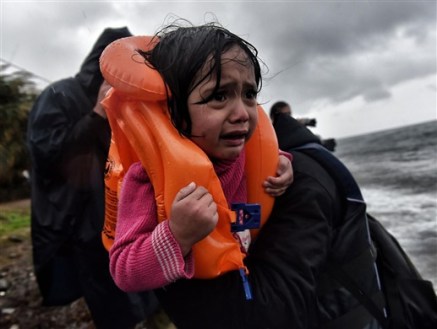
the headline starts with a huge number (10000) to grab the attention of the reader, then comes the shock “trafficked into sex work” which will convey more excitement, so people will now read the whole article. Moreover, the first paragraph goes along with the headline “At least 10,000 refugee children have vanished after arriving in Europe with many being forced into sex work and slavery” (Mtv, 2016) to create more drama and excitement.
Where the news come from says a lot about the news itself, in this article they used “officials believe”, showing no evidence of credible sources. The author tried to enlarge the numbers of children refugees as an extension of his tendency toward sensationalism, for example: “at least 10000 refugees”, “10000 plus children” and “thousands of young migrants”. Furthermore, the author used a sensationalized language in almost all the article such as “vanished”, “targeted by criminals”,” sexually exploited”, … additionally, in this article labels and titles are used to describe the refugee children such as “vulnerable children” which influence how the readers view those children, it victimizes them and make them more innocent in the eyes of the audience.
This article emphasizes the trafficking of Syrian refugees in Europe and ignores what is happening in the Middle East and specially in Lebanon. MTV is a local TV network in Lebanon and instead of talking about the trafficking that happened in Lebanon and the Syrian women that were forced into sex work in Jounieh, they decided to talk about the more newsworthy story. The purpose wasn’t to find a solution for what is happening and the causes of this trafficking are simplified.

Children and women are mentioned in almost every news story as an extension of the sensationalized treatment of crises, from the headline the reader can notice that it is a dramatic coverage and decide to continue reading because we are usually attracted to drama. Moreover, the first paragraph starts with a dramatic story of a woman “When her husband uprooted their family from Morocco to live under the Islamic State in Syria, Sarah Ibrahim had little choice but to go along. After he disappeared — she believes he was killed in an airstrike or a prison — she fled with her two sons” (Hubbard, 2018). To make the story seem more like a catastrophe disaster the author inflated the number of children and women, because readers tend to feel sorrier for the people they consider “weak”, for example: “more than 2,000 foreign women and children”, “more than 400 foreign fighters”, “more than 900 children”. In addition, to persuade the reader more and to create drama the author used negative words such as enormous mistake, unjustly paying, death sentences. Those words with negative connotation are to show that children and wives are unjustly paying for a small mistake and some of them didn’t even do it. The author called the jihadists “foreign fighters” in order to keep this spirit of tragic drama and to keep the audience with the fighters, the same person can be called “foreign fighter” or “terrorist” but the way a person is labeled can influence how the reader thinks about him.

Most people scan nearly all the headlines in an article without reading the whole text, if we only read the headlines in this article we can see that the author started with why the US shouldn’t accept Syrian refugees, which can lead readers to think that this is the most significant part of the story because most news stories are written in an inverted pyramid style. Strong headlines were made for why they shouldn’t, for example the first one is terrorists will slip into the country which may terrify citizens and influence their opinion but the headlines for why they should accept refugees weren’t this strong for example Refugees are incredibly unlikely to be terrorists, unlikely means that they can be and after the first paragraph readers will assume that the refugees can make terrorists slip into the US. In addition, the author tried to influence the reader by inflating numbers for example more than 60000$, upwards of 1.5 billion$, billions of dollars, more than 2 billion, over 12 million. Describing people by using titles or labels can be considered as a form of bias, the author used “middle eastern refugees” to describe Syrian refugees in the paragraph “The money could be spent helping Americans” in which the author implies that instead of helping middle eastern we should help Americans careless of whether middle eastern refugees are dying or starving without shelter as if Americans are the center of the universe (maybe that is what most of the news media today is doing). Furthermore, the author uses analogies and metaphors to influence the reader and to dramatize the story even more, “a use of metaphors and images can be a calculated attempt to seize an audience’s attention” (Moeller, 1999). For example, “It took just 19 terrorists to carry out the 9/11 attacks, killing thousands of Americans and launching two decades of war. Even a single terrorist can do horrific damage, as the attack in Nice, France proved”,” Terrorists have preferred other means of entering the country – the 9/11 hijackers, for example, entered on student or tourist visas” (the perspective, 2018). The author is generalizing and he made a whole statement out of one example without taking the circumstances and time of this example. Last but not least, it feels like the author implies not letting refugees in even when he is stating the arguments of why they should let them in, for example: “But even allowing a token number of Syrian refugees to settle in the US would be a measure of good faith in convincing world leaders that the US is doing its part in responding to the crisis”, “The U.S. refugee system can be, should be, and is being picky at who we allow to enter the U.S. as a refugee” , “America’s response to the Syrian refugee crisis evokes questions of American ideals, security, and the country’s place” ” (the perspective, 2018).
Hubbard, B. (2018, july 4). wives and children of ISIS. Retrieved from the new york times : http://www.nytimes.com
Moeller, S. D. (1999, december). four habits of international news reporting.
Mtv. (2016, february 1). 10000 refugee children trafficked into sex work . Retrieved from Mtv lebanon: http://www.mtv.com
Saad, H. (2018, july 11). memories lost and futures on hold. Retrieved from the new work times: http://www.nytimes,com
the perspective. (2018). Retrieved from the perspective: http://www.perspective.com
The article starts by justifying Israeli action: “the militant group that controls Gaza – was using Palestinian protests as a cover for launching attacks on Israel” (BBc news, 2018)
Then, the author mentions the praise for the soldiers who guarded the borders and let the Israelis celebrate in peace: “On Saturday, Israeli Prime Minister Benjamin Netanyahu praised soldiers for “guarding the country’s borders, allowing Israelis to celebrate the holiday [of Passover] in peace”.” (BBc news, 2018)
Finally, it ends by how many were killed and why the tension even happened.
2. Bias by headline:
“Gaza-Israel violence: Israel warns of action inside Gaza”, portrays Israel as completely innocent, and forced to react after being attacked or offended.
Pictures and angles used show the Palestinians attacking the “innocent” Israelis.

The title “Palestinian leader Mahmoud Abbas” was used to quote the Palestinian president.
While to refer to the Israeli leader, “Israeli Prime Minister Benjamin Netanyahu” was employed.
No specific numbers were given related to the Palestinian death toll, only general and blurry terms were used: “Most of the other dead” , “men under 40”
To refer to sources, terms like “A spokesman”, “The Palestinian side”, “Israeli officials” were used.
Bias in the news – WORKSHEET 2
Source (Use APA formatting: Author, A. A. (2018, April, 2“massacre in Gaza: Israeli forces open fire on Palestinians, killing 18, wounding as many as 1,700”. Democracy now. Retrieved from https://www.democracynow.org/2018/4/2/massacre_in_gaza_israeli_forces_open
The article starts by listing how many Palestinians were killed and how many Palestinians were wounded. The deaths and injuries were placed at the beginning to show the reader that this is the most important part of the story. “At least 18 Palestinians have died in Gaza after Israeli forces opened fire Friday on a protest near the Gaza Strip’s eastern border with Israel. As many as 1,700 Palestinians were wounded” (democracy now, 2018)
“massacre in Gaza: Israeli forces open fire on Palestinians, killing 18, wounding as many as 1,700” the title shows that Palestinians are innocent and Israelis are the ones that killed and attacked them.
The video posted shows the Palestinian ambassador in the UN talking about the “nonviolent protest” and then they show an interview with the director of the Palestinians center for human rights who insisted that the Israelis are talking the basic rights of the Palestinians.
“nonviolent protest”, “unarmed Palestinians”, these words were used to show that Palestinians are innocent and that they didn’t start the attack.
To make it sound like a total disaster and to show that a lot of Palestinians were killed, the author used words like “at least 18”, “as many as 1700” and “another 49”.
Thanks for joining me!
Good company in a journey makes the way seem shorter. — Izaak Walton

 Maria Issa, Media & Society