Syrian refugees are citizens of Syria, who have fled from their country since the onset of the Syrian civil war in 2011 and have sought asylum in other parts of the world. Here are 4 different stories about Syrian refugees from 4 different sources.
Memories Lost and Futures on Hold: A Look Inside a Camp for Syria’s Displaced (https://www.nytimes.com/2018/07/11/world/middleeast/syria-war-displaced-yarmouk.html )

Some people never make it past the headlines, thinking the entire story has been boiled down to that bold print. This headline is written in an emotional language and in bold, plus it includes the imagery “memories lost and futures on hold” to make a sensational statement and to grab the reader’s attention, thinking that a dramatic and sensationalized coverage makes readers believe that this merit their attention and will continue to read the whole article. Not only is the headline important but also the first paragraph usually contains the most important information because usually news stories are written in the “Inverted pyramid” style and here is where journalists fall in what is called bias through placement. This article is supposed to be about the camp and how Syrians are living in the camps but The first paragraph starts with “when Syrian government forces retook control of Rami al-Sayyed’s Damascus suburb” (Saad, 2018) and the author waits until the sixth paragraph to start talking about the way people are living in the camp, it is because he wants to show that the Syrian government is responsible of this crisis and of the “memories lost and futures on hold” and he ignores that the purpose of this article is to see what is inside the camp.
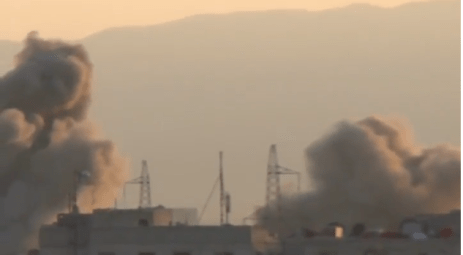
For a crisis to be newsworthy it should include the largest number of innocent people that were mistreated, that’s why in this article the numbers are usually inflated, for example “more than 6.6 billion” and “hundreds of thousands”. In addition, to persuade the reader more and to create drama the author used negative words such as the biggest shock, horrible camp and deep anxieties. As we can easily notice all the information in this article were provided by a Syrian refugee named Mr. Sayyed (even though nobody knows who is Mr. Sayyed and if he is a credible source or not) they didn’t include an interview of a person with the government nor the opinion of a politician, only information from one perspective are given which can lead to false prejudges.

10000 Refugee Children Trafficked into Sex Work:
(https://www.mtv.com.lb/news/articles/564105/10000_refugee_children_trafficked_into_sex_work )
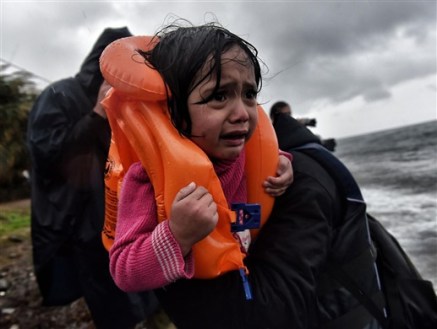
the headline starts with a huge number (10000) to grab the attention of the reader, then comes the shock “trafficked into sex work” which will convey more excitement, so people will now read the whole article. Moreover, the first paragraph goes along with the headline “At least 10,000 refugee children have vanished after arriving in Europe with many being forced into sex work and slavery” (Mtv, 2016) to create more drama and excitement.
Where the news come from says a lot about the news itself, in this article they used “officials believe”, showing no evidence of credible sources. The author tried to enlarge the numbers of children refugees as an extension of his tendency toward sensationalism, for example: “at least 10000 refugees”, “10000 plus children” and “thousands of young migrants”. Furthermore, the author used a sensationalized language in almost all the article such as “vanished”, “targeted by criminals”,” sexually exploited”, … additionally, in this article labels and titles are used to describe the refugee children such as “vulnerable children” which influence how the readers view those children, it victimizes them and make them more innocent in the eyes of the audience.
This article emphasizes the trafficking of Syrian refugees in Europe and ignores what is happening in the Middle East and specially in Lebanon. MTV is a local TV network in Lebanon and instead of talking about the trafficking that happened in Lebanon and the Syrian women that were forced into sex work in Jounieh, they decided to talk about the more newsworthy story. The purpose wasn’t to find a solution for what is happening and the causes of this trafficking are simplified.
Wives and Children of ISIS: Warehoused in Syria, Unwanted Back Home (https://www.nytimes.com/2018/07/04/world/middleeast/islamic-state-families-syria.html )

Children and women are mentioned in almost every news story as an extension of the sensationalized treatment of crises, from the headline the reader can notice that it is a dramatic coverage and decide to continue reading because we are usually attracted to drama. Moreover, the first paragraph starts with a dramatic story of a woman “When her husband uprooted their family from Morocco to live under the Islamic State in Syria, Sarah Ibrahim had little choice but to go along. After he disappeared — she believes he was killed in an airstrike or a prison — she fled with her two sons” (Hubbard, 2018). To make the story seem more like a catastrophe disaster the author inflated the number of children and women, because readers tend to feel sorrier for the people they consider “weak”, for example: “more than 2,000 foreign women and children”, “more than 400 foreign fighters”, “more than 900 children”. In addition, to persuade the reader more and to create drama the author used negative words such as enormous mistake, unjustly paying, death sentences. Those words with negative connotation are to show that children and wives are unjustly paying for a small mistake and some of them didn’t even do it. The author called the jihadists “foreign fighters” in order to keep this spirit of tragic drama and to keep the audience with the fighters, the same person can be called “foreign fighter” or “terrorist” but the way a person is labeled can influence how the reader thinks about him.
should the US accept Syrian refugees?
(https://www.theperspective.com/debates/politics/us-accept-syrian-refugees/ )
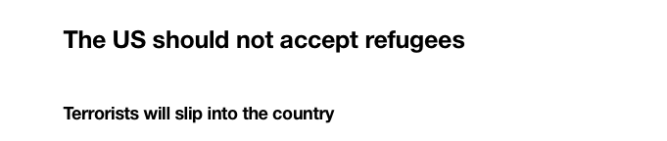
Most people scan nearly all the headlines in an article without reading the whole text, if we only read the headlines in this article we can see that the author started with why the US shouldn’t accept Syrian refugees, which can lead readers to think that this is the most significant part of the story because most news stories are written in an inverted pyramid style. Strong headlines were made for why they shouldn’t, for example the first one is terrorists will slip into the country which may terrify citizens and influence their opinion but the headlines for why they should accept refugees weren’t this strong for example Refugees are incredibly unlikely to be terrorists, unlikely means that they can be and after the first paragraph readers will assume that the refugees can make terrorists slip into the US. In addition, the author tried to influence the reader by inflating numbers for example more than 60000$, upwards of 1.5 billion$, billions of dollars, more than 2 billion, over 12 million. Describing people by using titles or labels can be considered as a form of bias, the author used “middle eastern refugees” to describe Syrian refugees in the paragraph “The money could be spent helping Americans” in which the author implies that instead of helping middle eastern we should help Americans careless of whether middle eastern refugees are dying or starving without shelter as if Americans are the center of the universe (maybe that is what most of the news media today is doing). Furthermore, the author uses analogies and metaphors to influence the reader and to dramatize the story even more, “a use of metaphors and images can be a calculated attempt to seize an audience’s attention” (Moeller, 1999). For example, “It took just 19 terrorists to carry out the 9/11 attacks, killing thousands of Americans and launching two decades of war. Even a single terrorist can do horrific damage, as the attack in Nice, France proved”,” Terrorists have preferred other means of entering the country – the 9/11 hijackers, for example, entered on student or tourist visas” (the perspective, 2018). The author is generalizing and he made a whole statement out of one example without taking the circumstances and time of this example. Last but not least, it feels like the author implies not letting refugees in even when he is stating the arguments of why they should let them in, for example: “But even allowing a token number of Syrian refugees to settle in the US would be a measure of good faith in convincing world leaders that the US is doing its part in responding to the crisis”, “The U.S. refugee system can be, should be, and is being picky at who we allow to enter the U.S. as a refugee” , “America’s response to the Syrian refugee crisis evokes questions of American ideals, security, and the country’s place” ” (the perspective, 2018).
References:
Hubbard, B. (2018, july 4). wives and children of ISIS. Retrieved from the new york times : http://www.nytimes.com
Moeller, S. D. (1999, december). four habits of international news reporting.
Mtv. (2016, february 1). 10000 refugee children trafficked into sex work . Retrieved from Mtv lebanon: http://www.mtv.com
Saad, H. (2018, july 11). memories lost and futures on hold. Retrieved from the new work times: http://www.nytimes,com
the perspective. (2018). Retrieved from the perspective: http://www.perspective.com

 Maria Issa, Media & Society